Chase Round-Up Account: 5% AER and the 12-Month Catch
The Chase round up account pays 5% AER variable on spare change, then moves it all to your current account after a year. How it works and how it compares.
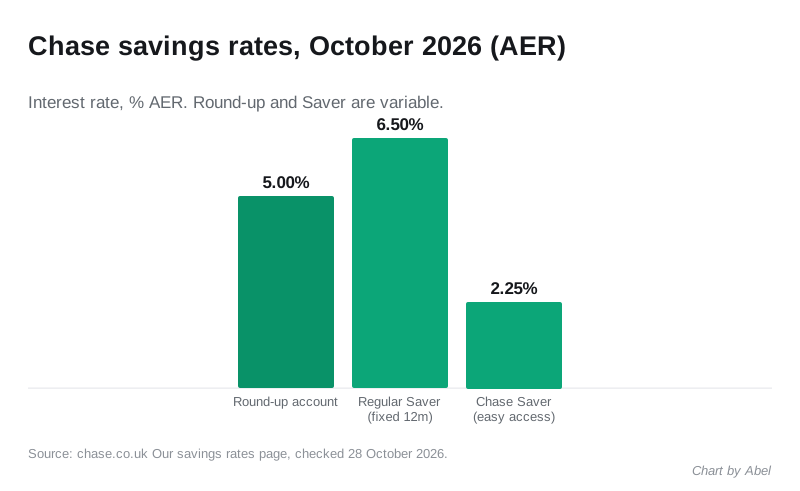
The Chase round up account pays 5.00% AER (4.89% gross, variable) on the spare change from your card spending, which is more than double the 2.25% AER on Chase’s own easy-access Saver. The catch is structural rather than hidden: the account is built for small sums, it only fills from round-ups, and on the anniversary of opening Chase sweeps the whole balance, interest included, back into your current account. It is a good nudge and a poor home for real savings.
We checked every figure on this page against Chase’s product page, its savings rates page and the round-up account terms on 28 October 2026.
How the Chase round-up account works
Switch it on in the Chase app (Save & Invest, then Add+, then Round-up). From then on, Chase rounds each debit card payment up to the nearest pound and moves the difference into the round-up account. Chase’s own example: spend £11.60 and 40p is saved.
The rules that matter, from the Chase round-up account terms:
- Rate: 5.00% AER variable, 4.89% gross. Interest is calculated daily and paid monthly.
- Source of money: round-ups on debit card payments. Chase describes the account only in terms of round-ups, so treat it as a round-ups-only pot, not a place to drop a lump sum.
- One at a time: you can hold only one round-up account.
- You need a Chase current account, and you must keep at least one other Chase account open. Close your last one and the round-up account closes with it.
- Withdrawals: any time, to another Chase account or to a UK bank account. There is no notice period or penalty.
- The annual sweep: each year, on the anniversary of opening, Chase moves the remaining balance, interest included, to the Chase current account you choose.
- Closing: free, at any time; the money and interest are paid out to you.
To open one you need to be 18 or over, a UK resident and UK tax resident, with a smartphone and a UK mobile number. Opening the Chase current account involves a soft credit search.
How much will you actually earn?
Less than the 5% headline suggests, because the balance starts at zero and grows slowly. Take someone who saves about £20 a month in round-ups (roughly 40 card payments averaging 50p of change each). After 12 months they have paid in £240. Because most of that money arrived in the later months, the interest at 4.89% gross comes to about £6 for the year, before the balance is swept out. Change the number of payments in our round-up savings calculator to see your own figure.
That is not an argument against it. The point of round-ups is the habit, and £240 you would not otherwise have saved beats £0 at any rate. Just do not mistake a 5% rate on a £100 average balance for a savings strategy.
Where the money goes after a year
This is the part people miss. The round-up account is not designed to hold money indefinitely. On the anniversary, the balance lands back in your current account, where it earns nothing and is easy to spend.
So set a reminder for the month before. Then decide where the year’s change should go: the Chase Saver (2.25% AER variable, linked to the Bank of England base rate), the Chase Regular Saver if you want a fixed rate on monthly deposits (6.50% AER fixed for 12 months on up to £300 a month, rate effective from 28 September 2026), or a cash ISA elsewhere. Our Chip vs Chase Saver comparison covers the easy-access option in more depth.
Chase vs Monzo and Starling round-ups
| Chase | Monzo | Starling | |
|---|---|---|---|
| Rounds to | Nearest £1 | Nearest £1 | Nearest £1 |
| Where it goes | Dedicated round-up account | A pot you choose | A Space you choose |
| Multiplier | None | 2x, 5x or 10x (Advanced roundups, paid plans) | 2x, 5x or 10x |
| Rate on the round-ups | 5.00% AER variable | Whatever the chosen pot pays | Whatever the chosen Space pays |
| Annual sweep | Yes, to your current account | No | No |
The difference is the trade-off between rate and flexibility. Chase pays a boosted rate on the round-up money itself but gives you no multiplier and no choice of destination. Monzo and Starling let you multiply each round-up and send it anywhere, but the money earns only what that pot or Space pays. Monzo lists Advanced roundups (2x, 5x or 10x) as a feature of its paid plans; Starling’s round-up page says you can increase round-ups to x2, x5 or x10 in the app.
If you would rather round up from a high-street bank account you already have, standalone apps such as Plum, Chip and Moneybox do it through Open Banking. Our best round-up savings apps compares them, and how round-up savings apps work explains the mechanics. For the full bank-against-bank picture, see Chase vs Monzo and Monzo vs Chase savings rates.
Is your money protected?
Chase UK is a trading name of J.P. Morgan Europe Limited, a bank, so eligible deposits are covered by the Financial Services Compensation Scheme up to £120,000 per person. The limit is per banking licence, so your round-up balance, Chase current account and any Chase savings count together.
Who it suits
- Good fit: you already use Chase as your spending account and want saving to happen without thinking about it. The rate is far better than leaving change in a current account.
- Poor fit: you want to build a large pot in one place, use a multiplier to save faster, or never want to remember an annual sweep date. A Monzo or Starling round-up into a decent savings pot, or a dedicated saver, will serve you better.
Frequently asked questions
What interest does the Chase round-up account pay? 5.00% AER (4.89% gross), variable, according to Chase’s savings rates page on 28 October 2026. Interest is calculated daily and paid monthly. Because the rate is variable, Chase can change it.
Can I pay money into the Chase round-up account manually? Chase describes the account only in terms of round-ups from debit card spending, and its product page and terms make no mention of manual deposits. Treat it as a round-ups-only account. For lump sums, use the Chase Saver or another savings account.
What happens to my round-ups after 12 months? On the anniversary of opening, Chase automatically moves the remaining balance, including interest, into the Chase current account you choose. The round-up account then carries on collecting for the next year.
Does Chase have a round-up multiplier? No. Chase rounds each debit card payment up to the nearest pound and offers no 2x, 5x or 10x setting. Monzo (on its paid plans) and Starling both offer multipliers.
Can I withdraw from the Chase round-up account early? Yes. You can move money out at any time to another Chase account or to a UK bank account, with no penalty and no notice.
Can I have more than one Chase round-up account? No. The terms allow one round-up account at a time, and you must keep at least one other Chase account open to hold it.