What Happens If a Fintech App Closes in the UK: 3 Outcomes
What happens if a fintech app closes in the UK depends on who holds your cash: a bank, an e-money firm or a platform. How to check yours in two minutes.
What happens if a fintech app closes in the UK comes down to one question that the app’s logo will not answer: which regulated firm is actually holding your money? The app on your phone is often just the front end. Behind it sits a bank, an e-money institution or an investment platform, and each of those fails in a different way, with different protection and a very different wait to get your money back.
There are two kinds of “closing”, and they are worth separating before anything else. An orderly wind-down is when a company runs out of funding or leaves the market, gives notice and asks you to move your money. An insolvency is when the firm itself collapses and an administrator takes over. The first is an inconvenience. The second is where the protection rules really matter.
A real wind-down: what Zero customers were told
The ethical money app Zero is a clean recent example. It ceased trading on 18 March 2026 after failing to raise more funding, and aimed to shut the app on 31 March. According to MoneySavingExpert’s report, it had 21,500 registered users, of whom about 7,500 used it regularly.
Zero’s customers held two different products, and they were protected in two different ways:
- The personal account was e-money, issued by Transact Payments Limited, not by Zero. It was not covered by the FSCS. The money sat in segregated accounts at an authorised credit institution, separate from TransactPay’s own funds, and anything left unclaimed was to be held for six years.
- The Planet Safe Saver was a savings account arranged through Bondsmith, with deposits held in ring-fenced accounts at Griffin Bank and fully FSCS protected. Balances were moved back to the personal account around 26 March so people could withdraw them.
Nobody lost money in that closure because the firm wound down in good order. But it shows the pattern: one app, three companies behind it, and two protection regimes.
Outcome 1: your money is held by a licensed bank
If the app is itself a bank (Monzo, Starling and Chase UK all hold UK banking licences), or it places your savings with a partner bank in your name, you are covered by the Financial Services Compensation Scheme if that bank fails.
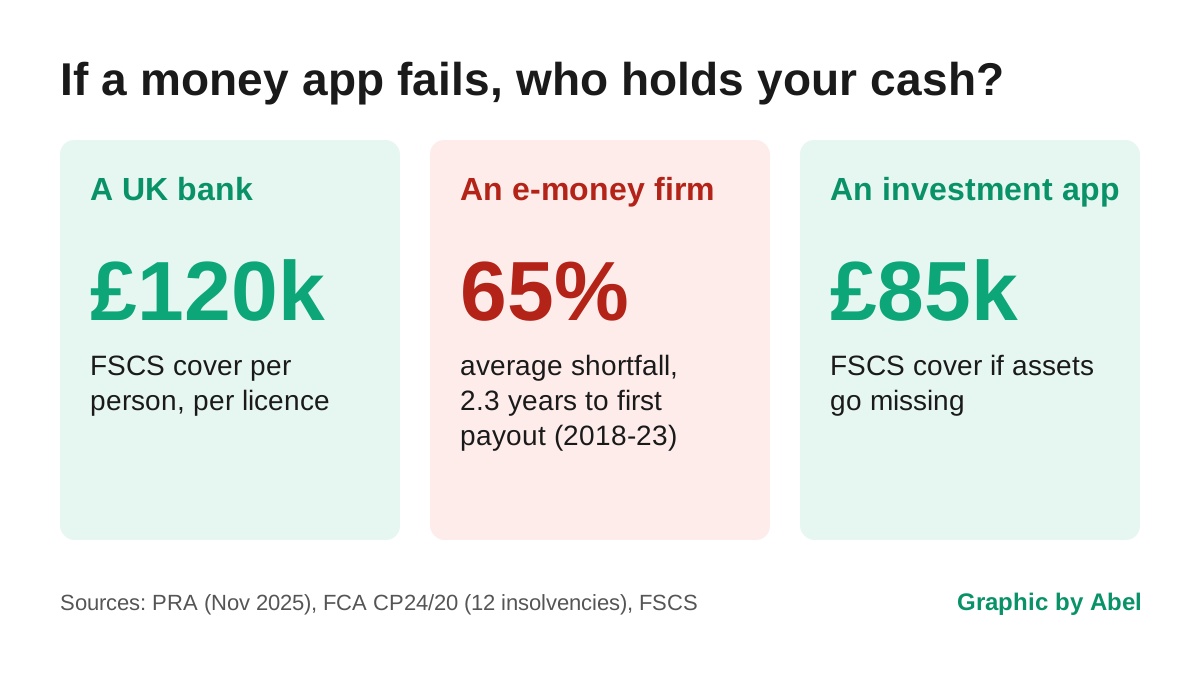
The deposit limit rose from £85,000 to £120,000 per person, per banking licence on 1 December 2025, confirmed by the Bank of England’s Prudential Regulation Authority. Two details catch people out:
- The limit is per licence, not per brand. Two apps that bank with the same partner, or two brands in the same banking group, can share a single £120,000.
- It protects you against the bank failing. If a savings app goes bust but your cash sits with a healthy partner bank, the money is still there; the practical job is getting it moved out, which the administrator or the bank handles.
FSCS aims to pay most deposit claims within seven days, which is why this is the best outcome of the three.
Outcome 2: your money is e-money
Many spending, prepaid and business apps are not banks. They are e-money or payment institutions, and the money in them is not covered by the FSCS if the firm fails. Instead the firm must “safeguard” it: keep customer funds separate from its own, usually in a designated account at a bank, so they can be handed back.
That is the theory. The FCA’s own numbers show how the practice has gone. Looking at 12 payment and e-money firms that became insolvent between early 2018 and mid 2023, the regulator found:
- a weighted average shortfall of 65% between what customers were owed and what was available, with 7 of the 12 cases short by more than half;
- an average of 2.3 years before customers received a first payment, in the cases where anything was paid at all (3.2 years for e-money firms alone);
- insolvency practitioners’ fees and expenses, around £0.8 million per case on average, taken out of client funds.
Those figures come from the FCA’s safeguarding consultation, CP24/20, and the FCA notes the shortfalls are probably underestimates.
The rules have tightened since. The FCA’s new safeguarding regime (policy statement PS25/12) took effect on 7 May 2026, requiring firms to reconcile safeguarded funds daily, file monthly safeguarding returns, get an annual safeguarding audit and keep a resolution pack an administrator can use to find customer money quickly. A special administration regime for payment and e-money firms, in force since 2021, also makes returning customer funds “as soon as reasonably practicable” an explicit objective. Neither turns e-money into a guaranteed deposit.
The other risk here is a freeze rather than a loss. On Friday 26 June 2020 the FCA stopped Wirecard Card Solutions from operating after its German parent collapsed, and customers of apps built on it, including Pockit, Anna Money and Curve, suddenly could not use their cards or reach their balances. Cards began working again by 30 June. Four days is short for a regulator, and long if your wages are in the account.
Outcome 3: your money is invested
Investing and ISA apps work differently again. Under the FCA’s client assets rules (CASS), your shares and funds are held by a nominee company on your behalf and ring-fenced from the platform’s own assets. If the platform fails, those holdings remain yours; the usual result is that an administrator transfers the whole book of accounts to another provider.
If assets have gone missing through fraud or poor records, the FSCS investment protection covers up to £85,000 per person, per firm. That limit did not rise with the deposit limit. Uninvested cash sitting in a platform account is usually held at a bank, so check whether the platform says that cash has deposit protection at the bank level.
Crypto held on an exchange has none of this. When Gemini closed UK accounts in April 2026, customers had a withdrawal-only window to move their coins elsewhere. There is no compensation scheme behind a crypto balance if an exchange collapses.
How to check what protects your app, in two minutes
- Find the firm in the app’s small print. Look at the bottom of the website or the “legal” section of the app for a sentence like “e-money services are provided by…” or “your deposits are held with…”. That name is the one that matters, not the app’s.
- Search that name on the FCA Financial Services Register. The entry says whether it is a bank (“accepting deposits”), an electronic money institution or an investment firm.
- Run the bank through the FSCS protection checker on fscs.org.uk if your money is meant to be deposit protected, and note which licence it shares with any other account you hold.
- Keep large balances where the protection is strongest. A spending app for day-to-day money is fine. Your emergency fund belongs in a covered savings account; our piece on where to keep an emergency fund goes through the options.
If your app announces it is closing
- Move the money out straight away, to a bank account in your own name. Do not wait for the final date, because card and transfer services often stop before the app does.
- Cancel or move direct debits and standing orders first, so bills do not bounce. Our walk-through on switching bank accounts covers the order to do it in.
- Download statements while you still can. You may need them to prove a balance to an administrator.
- Revoke any open banking connections the app held to your other accounts; see how to revoke open banking access.
- Watch for scam follow-ups. A closing app is a perfect pretext for “we need you to move your funds to a safe account” messages. No genuine firm asks that. If in doubt, call your bank on 159.
If the firm has gone into administration rather than winding down, you will usually be contacted by the administrator, who will ask you to confirm your balance and explain the claims process. Expect months, not days, for e-money.
For a wider look at how the licences differ, read are digital banks safe and is my money safe in an investing app.
Frequently asked questions
Is my money safe if a fintech app shuts down? It depends on the firm holding it. Money held by a UK bank is covered by the FSCS up to £120,000 per banking licence. E-money is safeguarded but not FSCS protected, and investments held under CASS should be transferred to another provider, with FSCS cover up to £85,000 if something is missing.
What happens if a fintech app closes in the UK and I don’t withdraw my money? Your balance does not disappear, but getting it back becomes slower. When Zero closed in 2026, e-money left in accounts was to be held by its issuer, Transact Payments, for six years, with customers asked to make contact by email to claim it.
Is e-money protected by the FSCS? No. The FSCS only steps in if the bank where an e-money firm safeguards its customer funds fails, not if the e-money firm itself fails. The FCA found average shortfalls of 65% in 12 payment firm insolvencies between 2018 and 2023.
How long does it take to get money back from a failed e-money firm? In the FCA’s review of 12 insolvencies, customers waited 2.3 years on average for a first payment where one was made, and 3.2 years for e-money firms. The new safeguarding rules from May 2026 are designed to shorten that.
How can I tell if my money app is a bank? Search the firm named in the app’s terms on the FCA Financial Services Register. A bank will have permission to accept deposits. If the register lists it as an electronic money institution, your balance is e-money, not a protected deposit.
What if my investing app goes bust? Your shares and funds are held by a nominee company separate from the platform’s own money, so they should be moved to another provider rather than lost. If assets are missing, the FSCS can pay up to £85,000 per person per firm.