Chase UK Review: 2% Cashback Rules and Every Rate Checked
Chase UK review, November 2026: 2% cashback capped at £20 a month if you hit two tests, savers from 2.25% to 6.5%, and what the app still cannot do.
This Chase UK review checks every number against Chase’s own product pages, terms and help centre on 6 November 2026. The short version: Chase is a free, app-only current account from J.P. Morgan that pays 2% cashback on everyday spending, capped at £20 a month, as long as you pass two monthly tests. Its savings rates range from 2.25% to 6.5% depending on the account. It pays no interest on the current account itself, offers no joint accounts and takes no cash.
Chase UK at a glance
| What | The detail on 6 November 2026 |
|---|---|
| Who runs it | Chase, a trading name of J.P. Morgan Europe Limited |
| Monthly fee | None |
| Cashback | 2% on set everyday categories, up to £20 a month, with conditions |
| Current account interest | 0.00% (stopped on 5 August 2024) |
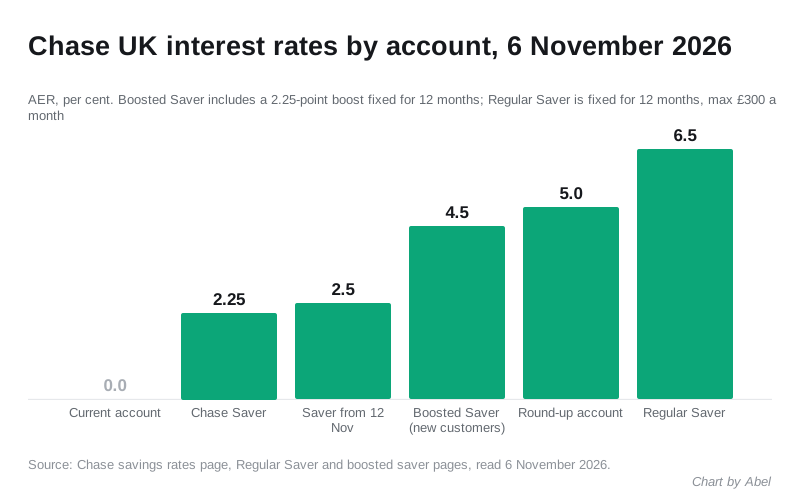
| Chase Saver | 2.25% AER variable, rising to 2.50% on 12 November 2026 |
| Boosted Saver | 4.5% AER for new customers who open it within 31 days of joining |
| Regular Saver | 6.5% AER fixed for 12 months, up to £300 a month |
| Round-up account | 5.00% AER variable, balance swept out each year |
| Spending abroad | No fees or mark-ups from Chase; Mastercard exchange rate |
| Deposit protection | FSCS, up to £120,000 |
| Joint accounts | Not offered |
| App rating | 4.9 out of 5 from about 288,000 ratings on the UK App Store |
How the 2% cashback actually works
Chase pays 2% cashback on debit and credit card spending in these categories: groceries and supermarkets, restaurants and cafes, takeaways, convenience stores, local and commuter transport (including TfL and Oyster top-ups), buses, railways, ferries, fuel, and public EV charging points. The cap is £20 a month, so the most you can earn is £240 a year, which takes £1,000 of eligible spending each month.
This version of the offer started on 1 June 2026. Some review sites still quote older terms, including a flat 1% on everything, so check the date on anything you read.
To earn cashback in a month, the Chase cashback terms say you must have done both of these in the previous calendar month:
- Made at least 15 payments by Chase debit card, Chase credit card or Direct Debit. Standing orders, bank transfers and refunds do not count.
- Kept £1,000 or more across your Chase saver accounts every day of the month. Money in the current account or round-up account does not count, and one day below £1,000 breaks it.
New customers get a grace period: the rest of the month they join plus the following month, during which cashback is paid without meeting either test. Join on 18 March and you earn from day one until 30 April, but you need to pass both tests during April to keep earning in May.
The exclusions matter more than the headline. Chase’s help page says you may not earn cashback if you pay through Curve or Klarna, that taxis are excluded from transport, that alcohol merchants such as Majestic Wine are excluded, and that concessions inside supermarkets (Argos, Habitat, Timpson) do not count. Home EV charging does not count either, and nothing earns cashback outside the UK and Channel Islands or in a currency other than sterling. Cashback lands in your rewards balance the month after you earn it.
Is it worth the hoops? If you already spend £500 a month on food, fuel and travel, that is £10 a month, or £120 a year, for keeping £1,000 parked in a Chase saver you would have needed anyway. The real cost is that the £1,000 earns 2.25% at Chase rather than a top easy-access rate; even a 2-point gap on £1,000 is only about £20 a year. For anyone spending a few hundred pounds a month in the eligible categories, the cashback wins.
Chase savings accounts compared
Chase has four places to put money, and they behave very differently. Every rate below comes from Chase’s savings rates page.
Chase Saver: 2.25% AER variable (2.23% gross). Easy access, as many saver accounts as you like, up to £3m. The rate is tied to Bank Rate: Chase sets it 1.50 points below the Bank of England base rate, five business days after each change. Chase’s page shows it rising to 2.50% AER on 12 November 2026.
Chase Saver with a boosted rate: 4.5% AER (4.41% gross). Only for new customers, who must open it within their first 31 days. It is the standard saver rate plus a 2.25-point boost fixed for 12 months, on up to £1m, one per customer. Chase says the offer can be withdrawn at any time. We cover the end-of-year drop in Monzo Pots vs Chase Saver.
Regular Saver: 6.5% AER fixed for 12 months (6.31% gross). Pay in up to £300 a month, counted from the day you open it. Withdrawals are allowed at any time to a Chase account with no penalty. Chase’s own table shows £300 a month for a year earns £125.53. After 12 months the balance and interest move to another Chase account and the Regular Saver carries on at whatever rate applies then.
Round-up account: 5.00% AER variable (4.89% gross). Only fills from rounding card payments up to the nearest pound; you cannot pay in any other way. The whole balance moves to a Chase account on each anniversary. Our Chase round-up account explainer runs the numbers.
Before switching savings over, compare Chase’s standard rate with the best easy-access savings apps: 2.25% is well behind the leaders, and it is the rate the boosted account falls back to after a year.
The everyday account
The current account is free, with no Chase fees on spending or withdrawing abroad, and it uses the Mastercard exchange rate without a mark-up. You can open extra current accounts for free and split money between them, which works much like spaces or pots elsewhere. Cards are numberless, with details kept in the app. Support is in the app, 24 hours a day.
There is no interest on the current account balance. Chase stopped paying it on 5 August 2024, so anything you are not about to spend belongs in a saver.
Switching is through the Current Account Switch Service in the app (Profile, then “Switch to us”), which Chase says moves your regular payments, Direct Debits and standing orders in 7 days.
What Chase does not do
- No joint accounts. Chase’s help centre says so directly.
- No cash or cheque deposits. Chase’s “adding money” help page lists only Faster Payments and BACS transfers. It cannot receive CHAPS or Swift payments either, which matters if you are being paid from abroad or completing on a house.
- No interest on the current account.
- No branches. Everything happens in the app; you need a smartphone and a UK mobile number.
If you need a joint account, a high-street bank or Monzo will suit you better; see Chase vs Monzo.
The credit card and investing
Chase also offers a credit card to existing current account customers. It earns the same 2% cashback (it shares the £20 monthly cap), charges no annual fee and no foreign transaction fees, and has 0% on purchases for up to 3 months. The representative APR is 24.9% variable on a £1,200 limit. Checking eligibility in the app does not affect your credit score.
Investing sits in the app as J.P. Morgan Personal Investing: managed portfolios inside a Stocks and Shares ISA, a Personal Pension or a General Investment Account. Capital is at risk, and the investment products are not guaranteed by Chase. If you want to pick your own shares or funds, look at our best investment apps instead.
Is Chase UK safe?
Yes, in the sense that matters. Chase is part of JPMorgan Chase, and eligible deposits with J.P. Morgan Europe Limited are protected by the Financial Services Compensation Scheme up to £120,000 per person. That limit covers all your Chase accounts together, current, saver and round-up. Our page on whether digital banks are safe explains how the cover works across apps.
Who Chase suits
- Good fit: you spend regularly on supermarkets, eating out, fuel or public transport, you can keep £1,000 in a Chase saver, and you will open the boosted saver and Regular Saver in your first month.
- Poor fit: you need a joint account, deposit cash, receive CHAPS or international payments, or want your main savings at a top rate after year one.
Many people run Chase alongside another account: Chase for the cashback card and first-year savings, something else as the main bank. Our best banking apps roundup sets it against Monzo, Starling and Revolut.
Frequently asked questions
Is Chase UK cashback 1% or 2%? 2%, capped at £20 a month, on groceries, restaurants and cafes, takeaways, transport, fuel and public EV charging. The current version started on 1 June 2026. You must make 15 card or Direct Debit payments and keep £1,000 in Chase savers every day of the previous month.
Does Chase UK pay interest on the current account? No. Chase stopped paying current account interest on 5 August 2024. Interest is paid only on its saver and round-up accounts.
Can I deposit cash into a Chase account? Chase’s help centre lists only bank transfers by Faster Payments and BACS as ways to add money. There is no cash or cheque route, and CHAPS and Swift payments cannot be received.
Does Chase UK offer joint accounts? No. Chase says it does not currently offer joint accounts, though you can open accounts in your own name.
Does opening a Chase account affect my credit score? Opening the current account involves a soft credit search, which lenders cannot see. Checking eligibility for the credit card in the app also has no impact; a full application does.
Is my money safe with Chase UK? Eligible deposits are protected by the FSCS up to £120,000 per person across all your Chase accounts, because Chase is a trading name of J.P. Morgan Europe Limited, a bank.
Sources
Chase product pages for the current account, Chase Saver, boosted saver, Regular Saver, round-up account and credit card; Chase cashback terms and conditions; Chase help centre pages on where cashback is earned, savings rates, current account rate, adding money, joint accounts and FSCS protection; Apple App Store (UK) listing for Chase UK. All read on 6 November 2026.