Lightyear Review 2026: 0.1% FX, £0 Commission, 3.89% Vaults
Lightyear charges no commission and 0.1% FX, the lowest of the big UK apps. What that saves on US shares, how Vaults pay 3.89%, and what it still lacks.
This Lightyear review comes down to one number: 0.1%. That is what Lightyear charges to convert pounds into dollars or euros when you buy an overseas share, and it is the lowest currency fee among the well-known UK investing apps. There is no account fee, no custody fee and no commission on UK, US or European shares, ETFs or gilts, in the Stocks and Shares ISA or the general account.
The catch is what is missing. Lightyear has no pension (SIPP), no Lifetime ISA and no Junior ISA, so it works as an ISA and share-dealing app rather than a home for all your money.
Every fee below was checked on Lightyear’s own UK pricing, Vaults and ISA pages on 2 November 2026. Rates on cash move with the Bank of England, so confirm them in the app before you open an account.
Lightyear at a glance
| What you pay or get | |
|---|---|
| Account or custody fee | £0 |
| Commission on UK, US and EU shares | £0 per order |
| ETFs and gilts | £0 per order (fund running costs still apply) |
| Currency conversion (FX) | 0.1% at the interbank rate |
| Vaults (money market funds) | 3.89% AER after Lightyear’s fee, in GBP, USD or EUR |
| Cash ISA | 3.75% AER, follows the Bank of England rate |
| Card deposit | 0.6% (bank transfers are free) |
| Accounts | Stocks and Shares ISA, Cash ISA, general account, business |
| Not offered | SIPP, Lifetime ISA, Junior ISA |
| Regulation | FCA authorised, FRN 987226 |
What Lightyear actually charges
For most people the bill is close to nothing. You pay no monthly fee and no dealing charge whether you buy £50 of a FTSE tracker or £5,000 of Apple. Lightyear makes its money in two places, and it says so on its pricing page: the 0.1% FX fee, and a cut of the interest earned on cash you hold with it.
UK shares still carry 0.5% stamp duty when you buy them. That is a government tax, not a Lightyear fee, and every UK platform passes it on. Most ETFs are exempt.
Funds have their own running costs, shown as the ongoing charge on each ETF. Lightyear does not add a platform percentage on top, which is the main difference from older platforms such as Hargreaves Lansdown that charge a yearly fee on the value of your shares and ETFs.
How much the 0.1% FX fee saves
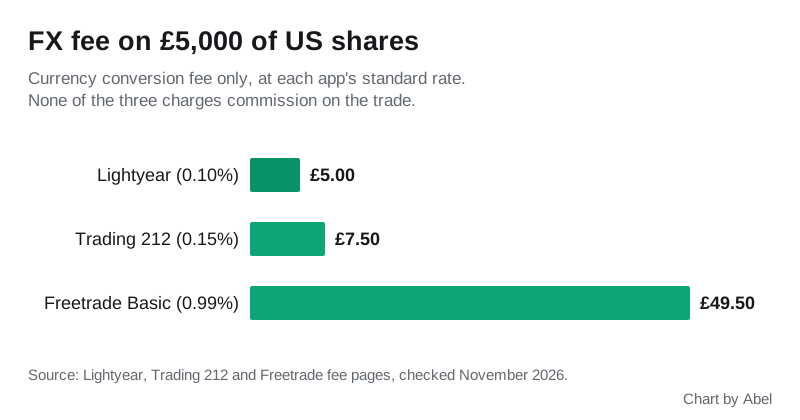
If you only buy UK shares and pound-priced ETFs, the FX fee never applies. It matters if you buy US shares directly. On a £5,000 purchase of US shares:
- Lightyear (0.10%): £5.00
- Trading 212 (0.15%): £7.50
- Freetrade Basic (0.99%): £49.50
The gap with Trading 212 is small and only shows up for heavy US investors. The gap with Freetrade’s free plan is large; our Trading 212 vs Freetrade comparison covers how Freetrade’s paid plans cut its FX fee.
Lightyear also lets you hold dollars and euros in its general account. If you sell a US share and buy another, you can stay in dollars and avoid converting twice. That multi-currency wallet is not available inside the ISA.
Interest on cash: Vaults and the Cash ISA
This is where Lightyear has changed most since launch. There are now three places for cash, and they are not the same thing.
Vaults pay 3.89% AER in pounds, dollars or euros. A Vault is a BlackRock money market fund, not a savings account. Lightyear’s Vaults page shows the working: the fund’s one-day yield was 4.02%, Lightyear takes a 0.20% fee, and the 3.89% figure is that net rate compounded monthly. You can use a Vault inside the Stocks and Shares ISA, so the interest is tax-free there. The rate changes daily, and your capital is technically at risk, although money market funds of this type hold very short-term, high-grade debt.
The Cash ISA pays 3.75% AER and tracks the Bank of England base rate. It is a flexible ISA with no withdrawal penalties.
Plain uninvested cash sitting in your account earns a lower rate than either. If you are holding money for more than a few days, move it into a Vault.
Is Lightyear safe?
Lightyear UK Ltd is authorised and regulated by the Financial Conduct Authority under FRN 987226; you can check it on the FCA register. Your shares are held in your name as beneficial owner and kept separate from Lightyear’s own assets, so they would not go to Lightyear’s creditors if it failed.
The FSCS position needs reading carefully, and Lightyear’s asset protection page is clear about it:
- If Lightyear failed and assets were missing, FSCS investment protection covers up to £85,000 per person.
- Uninvested pounds are split between UK banks (Citibank and NatWest) and qualifying money market funds. Only the part in UK banks gets FSCS deposit protection.
- Some euro cash sits with Citibank Europe in Germany, under the EU deposit scheme instead.
- Money in a Vault is a fund holding, not a deposit, so deposit protection does not apply.
None of this protects you from shares falling in value. If you want every pound of cash covered as a deposit, a bank-held Cash ISA elsewhere is the cleaner choice; our page on whether Plum is safe explains how FSCS works across apps.
What Lightyear is missing
- No SIPP. If you want a pension in the same app, look at our best SIPP apps.
- No Lifetime ISA or Junior ISA.
- No managed portfolios in the robo-adviser sense. Lightyear has three ready-made Plans built from BlackRock and Vanguard funds, but you pick and own them; nobody rebalances against a risk score for you.
- A younger, smaller firm. Lightyear started in Estonia and is much smaller than Trading 212 or Hargreaves Lansdown, though its UK arm is FCA authorised in its own right.
Who Lightyear suits
Lightyear is a strong pick if you buy US or European shares and want the lowest currency fee, or you want a free Stocks and Shares ISA where idle cash earns a competitive rate in a Vault. It is also a good second ISA for people who keep their pension elsewhere.
It is the wrong choice if you want one app for your ISA, pension and children’s savings, or if you want a fully managed portfolio. Compare it with the other picks in our best stocks and shares ISA apps and the Trading 212 review.
Frequently asked questions
Is Lightyear free to use? There is no account fee and no commission on shares, ETFs or gilts. You pay 0.1% if a trade needs a currency conversion, 0.6% if you top up by card, and the ongoing charge of any fund you hold. UK share purchases also carry 0.5% stamp duty, which is a government tax.
Does Lightyear have an ISA? Yes, two. The Stocks and Shares ISA is flexible, has no fees and lets you use Vaults for interest. The Cash ISA pays 3.75% AER and follows the Bank of England rate. Transfers in from another provider are free on Lightyear’s side.
Is Lightyear covered by the FSCS? Yes, up to £85,000 per person if Lightyear failed and your assets were missing. Cash deposit protection only applies to money held with its UK banks, not to money in Vaults or the qualifying money market funds it uses for some uninvested cash.
How do Lightyear Vaults pay interest? A Vault is a BlackRock money market fund. Lightyear shows the fund’s daily yield, takes a fee of 0.20%, and quotes the rest as an AER, currently 3.89%. The rate changes every day and is not guaranteed.
Does Lightyear have a SIPP? No. Lightyear does not offer a pension, a Lifetime ISA or a Junior ISA as of November 2026.
Is Lightyear better than Trading 212? Lightyear’s FX fee is lower, 0.1% against 0.15%, which only matters if you buy a lot of US shares. Trading 212 is the bigger, longer-established platform. For most investors the costs are close enough that the features you want should decide it.