Revolut Outage: Google Cloud Power Cut Lasted 6 Hours
A power cut at a Google data centre in London knocked Revolut, Lloyds and HSBC services over on 20 October. Plus iPhone tap to pay, ePayments and fraud.
A power cut at one Google data centre took several banking apps offline for most of Tuesday morning, the competition regulator wants Apple to open the iPhone’s tap-to-pay chip to rival wallets, an e-money firm has gone into special administration, and the latest crime survey shows bank and card fraud still rising. The first and third items are about what happens to your money when something breaks; the last is about keeping it.
A Google Cloud power cut disrupted Revolut, Lloyds and HSBC for about six hours
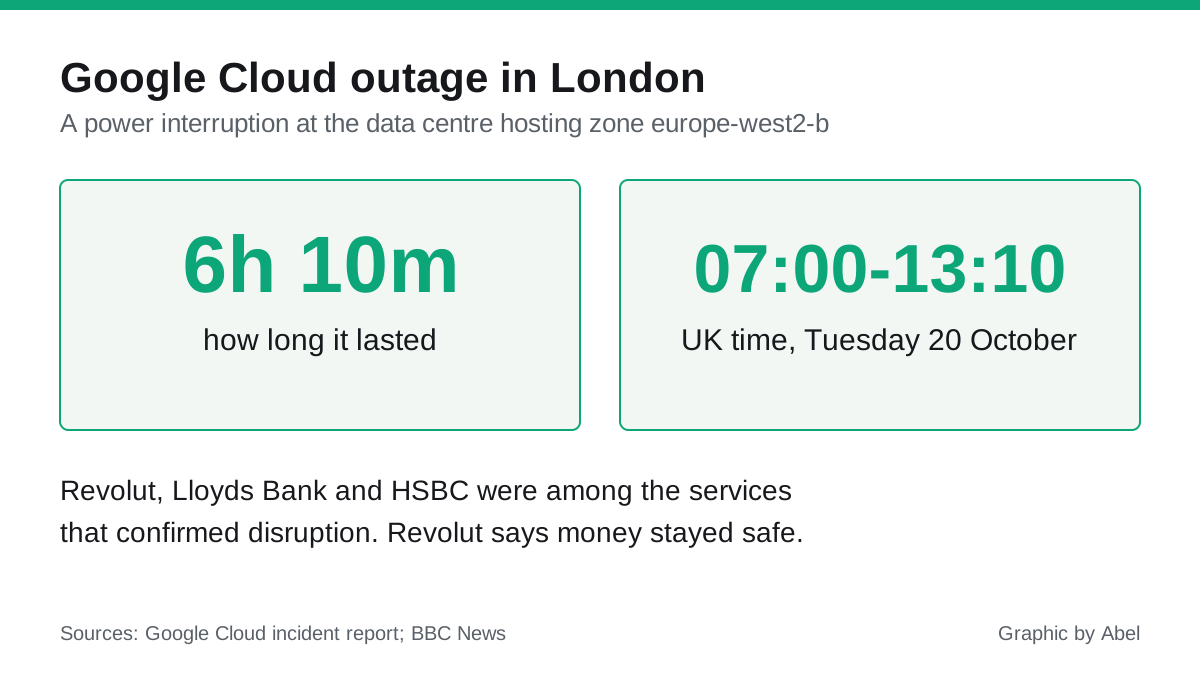
Google’s preliminary incident report, posted on 22 October, says an electrical power interruption at the facility hosting one zone of its London cloud region, europe-west2-b, took servers, network hardware and storage offline. The incident ran from 07:00 to 13:10 UK time on Tuesday 20 October, six hours and 10 minutes, and caused knock-on errors across the rest of the London region. The BBC reported that Revolut, Lloyds Bank and HSBC were among the services that confirmed disruption, with customers of Halifax and Bank of Scotland also reporting problems, and more than 1,500 reports about Revolut by shortly after 8am. Revolut told the BBC that services were fully restored and that customers’ money and data “remained safe throughout”.
An outage like this does not touch the money in your account, but it can stop you reaching it at the moment you need it. That is the practical case for keeping a second way to pay with a different bank, ideally one that does not run on the same cloud provider, and a little cash for parking and small bills. If a payment failed or you were charged a late fee because of the outage, keep the evidence and complain to the bank that let you down; if it does not resolve things within eight weeks you can go to the Financial Ombudsman. Are digital banks safe? covers the protections that do apply, and where to keep an emergency fund covers the backup account. Sources: Google Cloud incident report and BBC News.
The CMA wants Apple to let other apps use the iPhone’s tap-to-pay chip
The Competition and Markets Authority opened a consultation on 20 October on making Apple give other businesses access to the iPhone’s contactless (NFC) chip on fair terms. Apple currently offers UK developers only one of the two main technical routes, the “secure element”; the CMA’s proposal would require it to offer the other, host card emulation, as well, and set principles that it expects to lead to “substantially lower” fees than Apple charges now. The CMA says 62% of UK adults use a digital wallet and Apple Wallet is the most popular, but no firm has launched a rival tap-to-pay wallet on the iPhone here. In the EU, where Apple opened NFC access for payments, Vipps, PayPal, Klarna, Curve and BBVA have all launched one.
For iPhone users this could eventually mean paying in shops straight from your bank’s own app, or from a pay-by-bank app that takes money directly from your account rather than through a card. Nothing changes yet: the consultation closes on 17 November and a final decision comes after that. Best banking apps compares the apps that would be first in line. Source: GOV.UK.
E-money firm ePayments Systems has entered special administration
The FCA said on 15 October that ePayments Systems Limited, an authorised e-money issuer, entered special administration that day, with Mark Boast and Allister Manson of Opus Restructuring appointed as joint special administrators. They will gather information from customers and say how to make a claim “in due course”. The FCA’s own notice is blunt on protection: the Financial Services Compensation Scheme does not cover e-money or payment services. Instead the firm was required to keep customers’ money separate from its own, known as safeguarding, and the administrators will now check what is actually held.
This is the clearest example of the difference between a bank and an e-money app. Money in a UK bank is protected by the FSCS up to £120,000; money in an e-money account depends on safeguarding working, and getting it back through an administration can take months. If you had money with ePayments, contact the administrators through opusllp.com and ignore anyone who offers to recover it for a fee. What happens when a money app shuts down explains the process. Source: FCA.
Bank and card fraud rose 13% in a year, says the crime survey
The Office for National Statistics published its crime figures for England and Wales on 22 October. The Crime Survey estimates 4.5 million fraud incidents in the year to June 2026, up 11% from 4.1 million a year earlier, and the ONS puts the rise down to bank and credit account fraud, which went up 13% to 2.8 million incidents. Fraud reported directly to Report Fraud rose 15% to 348,944 offences, though the ONS says some of that is down to improvements in the reporting system.
Most bank fraud now starts with you being persuaded to do something: approve a payment, move money to a “safe account” or install an app. Turn on the card freeze, spending notifications and payee checks in your banking app, and never move money because someone who called you said so. Fake banking app scams shows what the copies look like. Source: ONS.