Savings Bonus Rate Ended? Switch Without Losing Interest
Savings bonus rate ended? Find the drop date, check the real rate left, then move cash or an ISA the safe way. Plum's 4.60% falls to 2.54%, for example.
If your savings bonus rate ended this month, or is about to, the money is still safe and still earning, just at a much lower rate. Most app savings accounts and cash ISAs advertise one headline figure that is really two numbers added together: a variable base rate plus a temporary bonus, usually for 12 months. When the bonus drops away you are left on the base rate, and nobody moves your money for you.
Here is how to find out when your bonus ends, what you will be earning afterwards, and how to move without losing interest or, for an ISA, the tax-free wrapper.
How a bonus rate is built
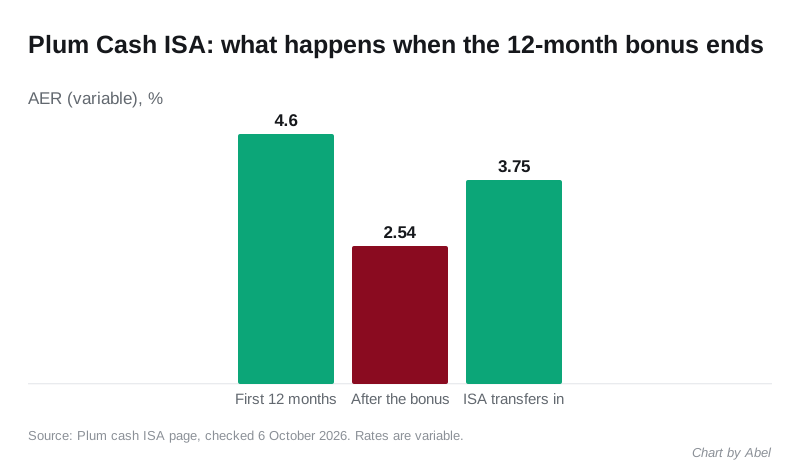
Take the Plum Cash ISA as a live example. In early October 2026 Plum’s cash ISA page showed 4.60% AER (variable) for the first 12 months. Of that, 2.06% is the bonus. After 12 months the rate falls to 2.54% AER. On £10,000, that is the difference between roughly £460 a year and £254 a year.
Plum is not unusual. Cash ISAs and easy-access accounts from investing apps, challenger banks and the big banks’ app-only savers often work the same way. Comparison tables in October 2026 listed 12-month bonuses from Trading 212, eToro, Plum, Cynergy Bank, Tembo and the Post Office, among others, with bonus portions ranging from about 1% to more than 3%. The bigger the bonus share of the headline rate, the harder the fall.
Three things vary between providers, and they decide what happens to you:
- When the 12 months start. Some count from the day you open the account, others from your first deposit. A few apply a separate clock to money transferred in.
- Whether transferred-in money gets the same bonus. Plum, for instance, pays a lower 3.75% AER (including a 1.21% bonus) on ISA transfers in, not the 4.60% headline.
- Conditions. Some bonus accounts cap the number of withdrawals or pay a lower rate if you exceed them. Read the summary box before you assume the headline applies to you.
How to find your drop date
You should not have to guess. Under the FCA’s banking conduct rules (BCOBS 4.1.2G), when an introductory, promotional or preferential rate ends on a set date, the provider should send notice on paper or in another durable medium (an email or a message in the app counts) a reasonable time before it ends. If that notice arrives more than 14 days ahead, it should send a reminder within the final 14 days.
There is a catch. That notice does not have to be sent if your balance is under £100 at the time. Small pots can slide onto the base rate without a word.
If you have not seen a notice, check these places in order:
- The account details screen in the app. Most show “bonus ends on” or “rate until” next to the balance.
- Your welcome email or the account’s summary box. Every savings account has one; it states the rate, how it is made up and how long any bonus lasts.
- Your account opening date. If the summary box says 12 months from opening, that date plus a year is your answer.
- Ask in-app chat. Ask for the exact date the bonus ends and the rate that applies afterwards. Write both down.
Put the date in your calendar a fortnight early. That gives you time to open a new account and, for an ISA, for the transfer to complete before the rate drops.
Is the rate you are left with still worth keeping?
Not always a reason to move. Compare your post-bonus rate against what you could get elsewhere today, without a bonus, so you are not just chasing the next 12-month teaser.
| Question | If yes | If no |
|---|---|---|
| Is the base rate close to the best no-bonus easy-access rates? | Staying put may be fine | Move |
| Is it an ISA you might top up again this tax year? | Check the new provider takes current-year money | Any ISA provider will do |
| Do you hold more than £120,000 with one banking group? | Split it, as FSCS protection covers £120,000 per person per banking licence | No action needed |
| Will you move again in 12 months? | Pick accounts that accept partial transfers | Consider a fixed rate instead |
Our best easy-access savings apps and best cash ISA apps comparisons split headline rates from bonus portions, so you can see the base rate you would land on in a year.
Moving ordinary savings
For a non-ISA easy-access account, switching is simple:
- Open the new account first and make a small test payment from your current account.
- Withdraw from the old account to your current account, then pay the new one. Most savings apps only let you withdraw to your nominated current account, so a two-step move is normal.
- Leave £1 behind only if the old app needs an open account for something else. Otherwise close it.
Interest is usually worked out daily and paid monthly or annually. You keep what has built up to the day you withdraw, but check whether the old account pays it on a fixed day. Moving a day after the payment date avoids a wait for a small final payment.
Interest from non-ISA savings counts toward your Personal Savings Allowance. If moving to a higher rate pushes your yearly interest over the allowance, our guide to tax on savings app interest explains what HMRC will collect.
Moving a cash ISA: never withdraw first
This is the mistake that costs people money for good. If you take cash out of an ISA and pay it into another ISA yourself, the second payment uses up this year’s allowance, and the old tax-free savings lose their wrapper. GOV.UK is blunt: if you withdraw instead of transferring, you will not be able to reinvest that part of your tax-free allowance again. The only exception is a flexible ISA, where you can put money back in the same tax year, and that only works within the same provider.
Do it as a transfer instead:
- Open the new ISA and start the transfer from the new provider’s app, not the old one. Look for “transfer an ISA” during sign-up or in the account menu.
- Choose full or partial. You can transfer all or part of your ISA savings at any time, including money paid in this tax year.
- Wait for the money to arrive. Cash ISA to cash ISA transfers should complete within 15 working days. Transfers involving other ISA types have 30 calendar days.
- Keep the old account open until the money lands. Closing it yourself can turn the transfer into a withdrawal.
Interest on the old ISA continues until the money leaves. A transfer takes a few days to three weeks, so start it before the bonus ends rather than on the day.
If you are under 65, remember the rules change on 6 April 2027. The cash ISA limit drops to £12,000 and you will no longer be able to transfer from a stocks and shares ISA into cash. Our explainer on the 2027 cash ISA limit covers what that means for moving money between apps.
Avoiding the same drop next year
- Write the end date down the day you open the account. The FCA reminder is a backstop, not a plan.
- Check the base rate, not just the headline. An account paying 4.4% with a 0.5% bonus will leave you better off in year two than one paying 4.6% with a 2% bonus.
- Look at fixed rates for money you will not touch. A one-year fix tells you the rate for the whole year, with no cliff edge in the middle.
- Keep your emergency money somewhere boring. Our guide to where to keep an emergency fund favours steady easy-access rates over teaser deals.
Frequently asked questions
Will my bank tell me before my savings bonus ends? It should. FCA guidance says providers should give notice before an introductory or promotional rate ends, and a reminder in the final 14 days if the first notice came earlier. The notice is not required if your balance is under £100.
Do I lose the interest I have earned if I move after the bonus ends? No. Interest earned at the bonus rate is yours. You only earn the lower rate from the day the bonus ends, so moving stops the loss going forward.
Can I transfer a cash ISA I opened this tax year? Yes. GOV.UK says you can transfer all or part of your ISA savings at any time, regardless of when you paid in. Start the transfer from the new provider’s app.
How long does a cash ISA transfer take? Cash ISA to cash ISA transfers should take no more than 15 working days. Other ISA transfers have up to 30 calendar days. Your money keeps earning interest at the old provider until it moves.
Can I get a second bonus by opening the same account again? Usually not. Most providers restrict bonuses to new customers or new accounts, and some exclude anyone who has held the product before. Check the eligibility section of the summary box.
Is it worth moving a small balance? It depends on the gap. On £500, a two percentage point difference is about £10 a year. It may be easier to leave it until you have a larger sum to move, but balances under £100 may not get a warning that the rate has dropped.
Sources
- Plum Cash ISA rates and bonus terms, checked October 2026
- FCA Handbook, BCOBS 4.1
- GOV.UK: transferring your ISA