Savings Pot vs Savings Account: Most Pots Pay 0%
Savings pot vs savings account: most budgeting pots pay no interest, savings pots do. How to tell which you have, plus FSCS, ISA and tax rules for each.
The savings pot vs savings account question sounds like a matter of wording, but it decides whether your money earns anything. In UK money apps, “pot” is used for two quite different things. One is a budgeting label that splits up the money in your current account and pays nothing. The other is a proper savings account that the app shows as a pot. Both look identical on screen, which is why people leave thousands sitting in pots earning 0% for years.
Here is how to tell which one you have, and what changes for interest, protection, ISAs and tax.
The short answer
| Budgeting pot or space | Savings pot | Standalone savings account | |
|---|---|---|---|
| What it is legally | Part of your current account balance | A savings account shown inside the app | A separate account, often with another bank |
| Earns interest | Usually no | Yes, variable | Yes |
| FSCS protected | Yes, as part of the bank balance | Yes, if the provider is a UK bank | Yes, if the provider is a UK bank |
| Counts toward the ISA allowance | No | Only if it is a Cash ISA pot | Only if it is an ISA |
| Interest is taxable | Not applicable | Yes, above your allowance | Yes, above your allowance |
Budgeting pots: tidy, protected, and paying nothing
Monzo says it plainly: its regular Pots are for budgeting and “don’t earn interest”. Only its Savings Pots do. A regular pot is a ring-fenced slice of your current account. It is useful for bills, holidays or a sinking fund (see sinking funds with apps), and the money is still covered by the FSCS because it sits in a bank. It just does nothing while it waits.
Other apps use different names for the same idea. Starling calls them Spaces, Revolut has had Pockets and Vaults, and Chase has round-ups that feed a separate account. The name tells you nothing about whether interest is paid. The product terms do.
Savings pots: a real savings account wearing a pot’s clothes
A savings pot is a savings product that the app displays alongside your other pots. On Monzo, Instant Access Savings Pots are provided by Monzo Bank itself, pay a variable rate monthly into the pot, allow unlimited withdrawals, and are open to anyone aged 16 or over with a Monzo current account. Monzo also offers Select Access and Fixed Rate pots, and Cash ISA pots, all inside the same app.
Starling went a step further in November 2024 by letting customers create named Spaces inside its Easy Saver account, up to 100 of them. A “Holiday” Space in the Easy Saver earns the Easy Saver rate; a Space attached to the current account does not. Same word, different account.
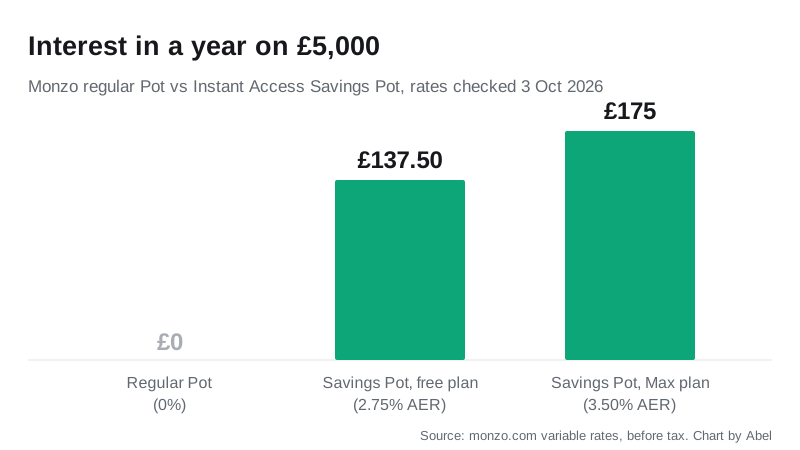
When we checked on 3 October 2026, the gap was large. Monzo was advertising 2.75% to 3.50% AER variable on Instant Access Savings Pots depending on the plan, against 0% on a regular pot. On £5,000 left alone for a year, that is £137.50 at 2.75% or £175 at 3.50%, before tax, against nothing at all (Max is a paid plan, so its higher rate only adds up if you already pay for it). Rates move with the Bank of England base rate, so check the app before you move money.
How to check what your pot actually is
- Open the pot and look for a rate. If the pot screen shows an AER and a monthly interest figure, it is a savings product. If it does not, assume 0%.
- Look for separate terms. A savings pot comes with its own terms and a summary box (the standard table showing the rate, access rules and who provides it). A budgeting pot is covered by your current account terms.
- Find the provider’s name. Some apps hold savings with a partner bank, not themselves. Revolut’s UK savings have been provided through Revolut Ltd with the money held at partner banks such as ClearBank. That is fine for protection, but it changes how the limit adds up (below).
- Check what happens with the interest. Savings pots usually pay monthly, into the pot. If nothing has ever appeared there, you have your answer.
FSCS protection: the limit is per bank, not per pot
The FSCS protects eligible deposits up to £120,000 per person, per bank, a limit that rose from £85,000 on 1 December 2025. Splitting money into ten pots at one bank does not give you ten limits. Monzo’s own wording is that the limit covers “money in your Savings Pots and Cash ISA Pots” together with the rest of what you hold with it.
Two traps catch people:
- Brands sharing one licence. The FSCS treats banks in one group that share a banking licence as a single bank. Check the FSCS protection checker before you spread money between brands.
- Partner-bank savings. If an app places your savings with a partner bank, the limit applies at that partner. Money you hold directly with the same partner bank counts toward the same £120,000.
A temporary high balance, such as house sale proceeds or a redundancy payment, can be protected up to £1.4 million for six months. That is worth knowing if a pot is about to hold a deposit. E-money apps are different: they safeguard your balance but are not FSCS protected. Our page on whether digital banks are safe covers that difference.
ISAs: a pot is only an ISA if it says so
An ordinary savings pot is not an ISA, so its interest counts as taxable savings income. A Cash ISA pot is an ISA and uses your annual allowance, currently £20,000 across all your ISAs. The government has announced the cash ISA limit falls to £12,000 from 6 April 2027 for under-65s, with the overall £20,000 ISA allowance staying in place. If you are choosing between a plain savings pot and an ISA pot, our best Cash ISA apps page compares the options.
Tax: savings pot interest counts like any other
Interest from a savings pot adds to all your other savings interest for the tax year. The Personal Savings Allowance shelters £1,000 for basic rate taxpayers and £500 for higher rate taxpayers; additional rate taxpayers get nothing. Banks report interest to HMRC, so you do not need to declare it yourself unless you are in Self Assessment. From 6 April 2027 the tax rates on savings income above the allowance rise by two percentage points, to 22%, 42% and 47%. Our explainer on tax on savings app interest works through examples.
A budgeting pot earns nothing, so there is nothing to tax.
When each one makes sense
- Budgeting pot: money you will spend within weeks, such as rent, bills or this month’s food. Instant, no rules, no need for interest.
- Savings pot: money you are setting aside for months and want in the same app, such as an emergency fund or a holiday next year. Check the rate is competitive, not just convenient.
- Standalone savings account: larger sums where the best rate matters more than seeing it on your home screen. Compare it against the best easy access savings apps, and consider Premium Bonds if you are a higher rate taxpayer near your allowance.
A simple rule: anything you will not spend in the next month should not be in a 0% pot.
Frequently asked questions
Do savings pots earn interest? Savings pots do, budgeting pots usually do not. On Monzo, for example, regular Pots pay no interest and Instant Access Savings Pots pay a variable rate monthly. Open the pot: if no AER is shown, it is paying nothing.
Is a savings pot a separate account? A savings pot is a separate savings product with its own terms, even though it appears inside your current account app. A budgeting pot is part of your current account balance.
Is money in a pot protected by the FSCS? Yes, if the provider is a UK bank, but the £120,000 limit is per person per bank, not per pot. All your pots and accounts with the same bank share one limit.
Is a savings pot an ISA? No, unless the app labels it a Cash ISA pot. Ordinary savings pot interest is taxable above your Personal Savings Allowance.
Do I pay tax on savings pot interest? Only if your total savings interest for the year goes over your Personal Savings Allowance: £1,000 for basic rate taxpayers and £500 for higher rate. Your bank reports the interest to HMRC.
Can I withdraw from a savings pot instantly? Instant access pots, yes. Select access pots limit how often you can withdraw before the rate drops, and fixed rate pots lock the money for the term.
Sources
- Monzo, Instant Access Savings, checked 3 October 2026
- FSCS, Check your money is protected
- Starling Bank, Easy Saver product page and terms