Stamp Duty on Shares in UK Apps: 0.5%, and Who Skips It
Stamp duty on shares is 0.5% of every UK share purchase in any app, ISA included. ETFs, most AIM shares and US stocks pay nothing. Checked 11 Nov 2026.
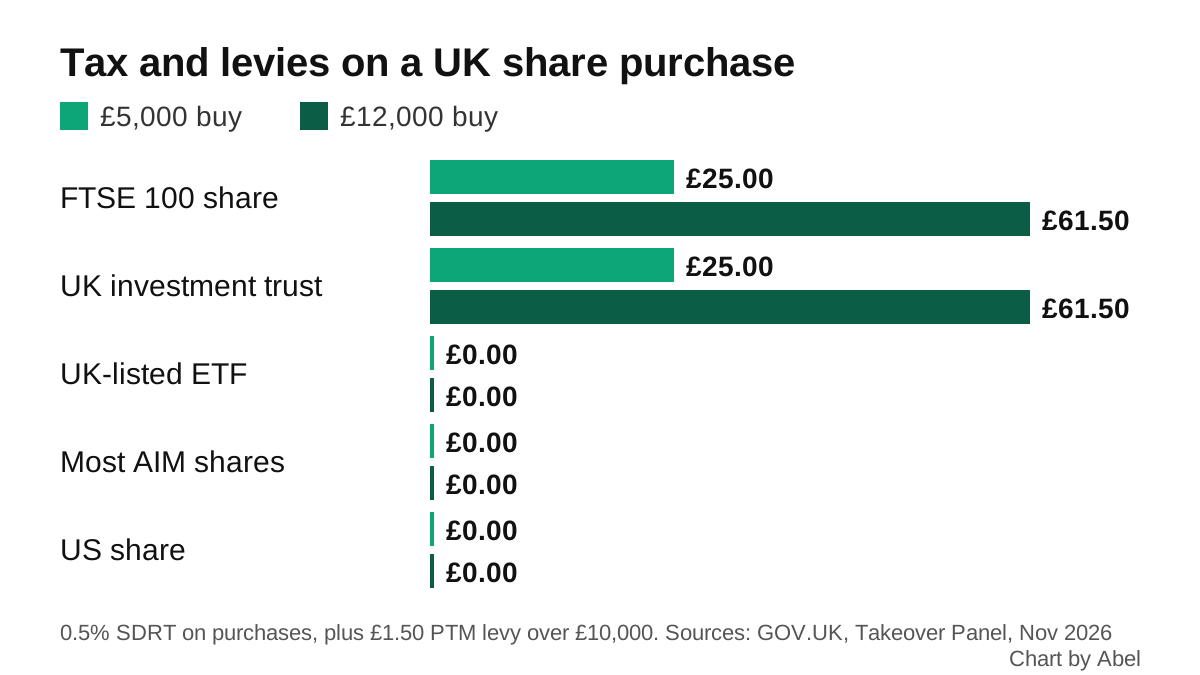
Stamp duty on shares in the UK is 0.5% of the price you pay when you buy shares in a UK company, and every investing app charges it, including inside a Stocks and Shares ISA or a SIPP. Buy £5,000 of a FTSE 100 company and £25 goes to HMRC on top of the price. UK-listed ETFs, most AIM shares and US shares carry no stamp duty at all, which is why the same £5,000 can cost you £25 more or nothing depending on what you buy.
The app is not choosing to charge you. It collects the tax for HMRC, so a “commission-free” app and a traditional broker take exactly the same 0.5%. We checked the rules below on GOV.UK, the Takeover Panel’s website and the help centres of Trading 212 and Freetrade on 11 November 2026, two weeks after the 28 October Budget.
What the 0.5% actually is
When you tap buy in an app, the trade settles electronically through CREST, the UK’s share settlement system. That makes the tax Stamp Duty Reserve Tax (SDRT), not stamp duty in the old paper sense, though apps and HMRC both use “stamp duty” loosely for it. GOV.UK sets out the rules on its Tax when you buy shares page:
- Rate: 0.5% of what you pay, taken automatically when the trade settles. You do not report it or pay it yourself.
- Purchases only. Selling shares carries no SDRT.
- No minimum. Electronic purchases are taxed from the first penny. The £1,000 threshold you may have read about applies only to paper stock transfer forms, where the duty is rounded up to the nearest £5.
- ISAs and pensions do not help. The wrapper shelters your gains and dividends from tax, but SDRT is a tax on the purchase itself, so you pay it inside an ISA, a Lifetime ISA, a Junior ISA and a SIPP.
What does and does not pay stamp duty
| You buy | Stamp duty (SDRT) | Why |
|---|---|---|
| Shares in a UK company on the LSE main market (Lloyds, BP, Tesco) | 0.5% | The standard charge |
| UK investment trusts and REITs | 0.5% | They are UK companies, so their shares are taxed like any other |
| UK-listed ETFs | None | Exempt; Trading 212 and Freetrade both say so in their help centres |
| Funds bought from the manager (OEICs, unit trusts) | None | GOV.UK lists these as exempt |
| Most AIM shares | None | Exempt since April 2014, unless the company is also listed on a recognised exchange |
| A company that listed on the main market on or after 27 November 2025 | None for three years | The UK listing relief from the 2025 Budget |
| US shares (Apple, Nvidia) and other foreign shares bought abroad | None | Outside the UK tax; other countries may have their own |
| Gilts and corporate bonds | None | Not shares |
Two rows in that table catch people out.
Investment trusts are taxed, ETFs are not. A global tracker ETF and a global investment trust can hold similar companies, but the trust is a UK-incorporated company and its shares carry 0.5% on every purchase. In a recent count Fidelity found 103 of the 378 trusts on the AIC list were registered outside the UK, and those avoid the charge. The Association of Investment Companies has campaigned for years to end what it calls double taxation; so far nothing has changed.
AIM shares are “most”, not “all”. Trading 212’s help centre is careful to say that most AIM stocks are exempt. A company traded on AIM that also lists on a recognised exchange elsewhere loses the exemption, so check the order screen before you assume.
The PTM levy: the other charge on big trades
If a trade is worth more than £10,000, you also pay the PTM levy, a flat £1.50 that funds the Takeover Panel. It is not a tax and it is tiny next to stamp duty, but it shows on your contract note and confuses people because:
- it applies to sales as well as purchases, unlike SDRT;
- it is per trade, so £10,001 and £500,000 both pay £1.50;
- it covers shares of UK, Channel Islands and Isle of Man companies traded on a UK market, and the Takeover Panel’s PTM levy page states it is not charged on ETFs or other open-ended funds.
The Panel raised it from £1 to £1.50 on 2 December 2024, the first change since 2002.
What it costs: three worked examples
These use the rules above. App dealing fees are left out, because Trading 212, Freetrade and InvestEngine charge none on UK trades; a broker such as Hargreaves Lansdown adds its own commission on top.
- £5,000 of a FTSE 100 share: £25 SDRT. Sell it later for £6,000: nothing on the sale.
- £12,000 of a FTSE 100 share: £60 SDRT plus £1.50 PTM levy, so £61.50. Sell it for £12,000: £1.50 PTM levy.
- £12,000 of a UK-listed global ETF: nothing. No SDRT, no PTM levy.
If you invest monthly in individual UK shares, the 0.5% repeats on every purchase. Over a year of £500 monthly buys, that is £30 gone before the shares have moved, the same whichever app you use. In a cheap ETF it is zero, which is part of why ETF portfolios dominate the best investment apps in the UK.
Other countries’ share taxes you will meet in apps
Stamp duty is a UK tax, but apps that offer European shares pass on local equivalents. Trading 212’s fee page lists the French Financial Transaction Tax at 0.4% on purchases of French companies with a market value over €1 billion, such as LVMH or TotalEnergies. On US shares there is no purchase tax, but small US regulatory fees are charged on sales: an SEC fee on the value and a FINRA fee per share sold, each usually pennies. The bigger cost on US shares is usually the currency conversion fee, which we compare in Trading 212 vs Freetrade.
What changes in 2027
The 28 October 2026 Budget confirmed that stamp duty and SDRT on shares will be replaced by a single Securities Transfer Tax from late 2027, through the Finance Bill 2026-27. The rate is not changing; the Association of Investment Companies described it as “a technical change, not a change to the level of taxation”. The Treasury said it would keep a cut “under review”, which is not a promise. Until then, assume 0.5% on UK shares and plan around it.
How to keep stamp duty down
- Use ETFs for your core holdings. A UK-listed ETF tracking the FTSE 100 gives you the same companies with no SDRT and no PTM levy. InvestEngine only sells ETFs, so it never charges stamp duty.
- Buy less often, in bigger amounts, if you hold individual UK shares. The 0.5% is the same either way, but fewer trades means fewer PTM levies on purchases over £10,000 and less temptation to churn.
- Check before buying an investment trust. If two trusts do the same job and one is registered in Guernsey or Jersey, the overseas one has no stamp duty.
- Do not sell to avoid it. Stamp duty is a one-off cost on buying. Selling and rebuying a UK share to move it between accounts charges you twice; transfer it instead, as covered in how to transfer an ISA between apps.
Frequently asked questions
Do I pay stamp duty on shares in a Stocks and Shares ISA? Yes. The ISA protects your gains and dividends from tax, but stamp duty is a tax on the purchase, so 0.5% is still taken when you buy UK shares inside an ISA, a Lifetime ISA or a SIPP.
Do I pay stamp duty when I sell shares? No. SDRT is charged only on purchases. On a sale over £10,000 of a UK company’s shares you will see the £1.50 PTM levy, which is not a tax.
Is there stamp duty on ETFs in the UK? No. UK-listed ETFs are exempt from SDRT and from the PTM levy, which is why buying an ETF costs nothing in tax in Trading 212, Freetrade or InvestEngine.
Do investing apps charge stamp duty on US shares? No. UK stamp duty does not apply to shares in US companies bought on US exchanges. You may pay a currency conversion fee, and small US regulatory fees when you sell.
Is there a minimum amount before stamp duty on shares applies? Not for electronic trades, which is what every app uses. The £1,000 threshold only applies to shares bought on a paper stock transfer form.
Is stamp duty on shares being scrapped? No. From late 2027 it becomes the Securities Transfer Tax, but the Budget of 28 October 2026 kept the 0.5% rate. Newly listed companies get a three-year exemption, which started on 27 November 2025.