How to Open a Cash ISA in an App: 6 Steps, 10 Minutes
How to open a cash ISA in an app: have your NI number ready, check it is flexible, never withdraw an old ISA to move it. Six steps, plus the April 2027 cap.
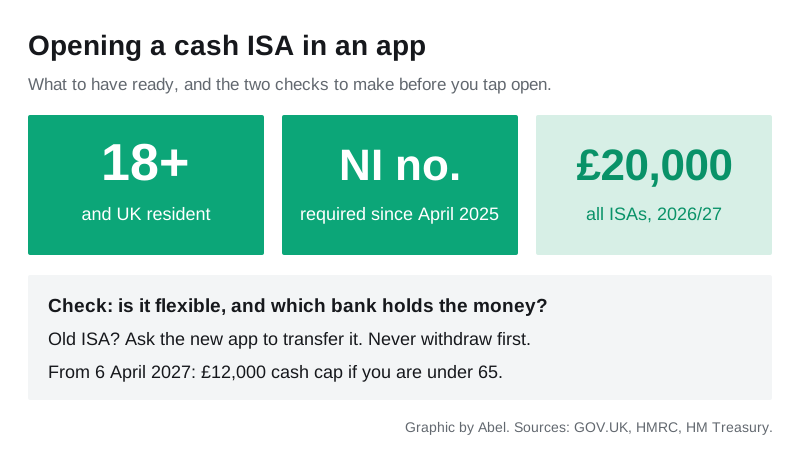
Knowing how to open a cash ISA in an app takes about ten minutes, and most of that is the identity check. You need to be 18 or over, live in the UK, and have your National Insurance number to hand. The part that deserves more care is not the form. It is the three questions you should answer before you tap “open”: is this ISA flexible, which bank actually holds the money, and are you bringing an old ISA with you?
This page walks through the sign-up in the order the apps ask for things, then covers the rules that have changed since 2024 and the one coming in April 2027. We checked the rules against GOV.UK and HMRC guidance on 27 October 2026.
Before you start: what you need
- Age 18 or over. GOV.UK is plain about it: “You must be 18 or over to open an ISA.” Since April 2024, 16 and 17 year olds can no longer open an adult cash ISA. Under-18s use a Junior ISA instead.
- UK residence. You must be resident in the UK, or a Crown servant or member of the armed forces (or their spouse or civil partner) serving abroad.
- Your National Insurance number. Since 6 April 2025, HMRC’s Tax-free savings newsletter 14 says new ISAs “must contain the investor’s National Insurance number unless the investor is ineligible to have one”. The app will check the format (two letters, six digits, a final letter A to D). It is on your payslip, P60 or any HMRC letter, and in the HMRC app.
- Photo ID and a selfie, if you are new to the app. Passport or driving licence covers almost every provider.
- A UK bank account in your name to pay in from and withdraw to.
You cannot open an ISA jointly. Each person needs their own.
How to open a cash ISA in an app, step by step
1. Decide which app, using three checks rather than the rate
Rates on app ISAs move with the Bank of England and with introductory bonuses that drop off after a year, so the number on the day is the least durable thing you can choose on. Check these instead:
- Is it flexible? A flexible ISA lets you take money out and put it back in the same tax year without using more allowance. GOV.UK’s example: pay in £10,000, withdraw £3,000, and you can still pay in £13,000 more if the ISA is flexible, but only £10,000 if it is not. Monzo says all its cash ISAs are flexible, and Trading 212’s cash ISA is flexible too. If the app does not say, ask before you deposit.
- How many withdrawals? Some higher-paying tiers limit you to a few withdrawals a year. That is fine for a house deposit and wrong for an emergency fund.
- Who holds the money? Many apps are not banks. Your FSCS protection (£120,000 per person, per bank) sits with the partner bank, so money you already hold there counts towards the same limit. Our explainer on which savings apps use ClearBank shows how that adds up.
Our best cash ISA apps comparison sets the main apps side by side on these points.
2. Check the product is actually open to you
Apps close and replace ISA products more often than banks do, and the old one can stay visible in the app for existing customers. Chip is a recent example: its help centre says the original Chip Cash ISA stopped taking new customers and transfers in from 10 June 2026, with the Smart Cash ISA as its replacement. Chip’s help pages also say the Smart Cash ISA does not currently accept transfers from other providers. If you plan to bring an old ISA across, confirm the new product takes transfers in before you open it.
3. Create or log in to your account and pass the ID check
New customers go through the usual know-your-customer check: name, address history, date of birth, a photo of your ID and a short selfie video. This is the step that takes time. If the app cannot verify you automatically it may ask for a utility bill or bank statement, which can add a day or two.
4. Enter your National Insurance number and make the declaration
The app will ask for your NI number and then show an ISA declaration: that you are eligible, that you will not go over the annual allowance, and that the information is correct. Read it. It is the legal basis for your tax-free status, and HMRC can void subscriptions over the limit.
If you do not have an NI number and are entitled to one, apply first. GOV.UK says it can take up to four weeks to arrive. The “I do not qualify for one” route only applies to people who are genuinely ineligible, and not to Lifetime or Junior ISAs.
5. Choose new money or a transfer
This is the step people get wrong. The app will usually offer two routes:
- Pay in new money from your bank account. That uses this year’s allowance.
- Transfer an existing ISA from another provider. Choose this if you have old ISA savings, because it keeps them tax-free and does not touch this year’s allowance (unless it includes money paid in this tax year).
Never withdraw money from an old ISA to pay it into the new one. Once it leaves the wrapper, previous years’ savings lose their ISA status and paying them back in counts as new money. The new app runs the transfer for you; GOV.UK caps a cash ISA to cash ISA transfer at 15 working days. Our guide to transferring an ISA to another provider covers partial transfers and what to do if one stalls.
6. Fund it and check the first statement
Make your first deposit, then check the app shows it as an ISA balance and not an ordinary savings pot. Some apps keep both side by side and a mis-tap lands money in the taxable one. Once the money has landed, note when any introductory bonus ends so you can review the rate when it does.
The rules that changed since 2024
Three changes from April 2024 make opening a second or third cash ISA much easier than it used to be:
- You can pay into more than one cash ISA in the same tax year. GOV.UK’s own example: £10,000 in one cash ISA, £3,000 in another and £7,000 in a stocks and shares ISA in a single year. The old one-cash-ISA-a-year rule is gone.
- Partial transfers of this year’s money are allowed. You no longer have to move everything you paid in this tax year in one lump.
- The minimum age for an adult cash ISA went up to 18.
The total across all your ISAs still cannot go over £20,000 in the 2026/27 tax year, which runs to 5 April 2027. Each app sees only its own deposits, so if you split new money across two cash ISAs, keeping the running total is your job.
The April 2027 change to plan around
From 6 April 2027 the most an under-65 can pay into cash ISAs in a tax year falls from £20,000 to £12,000. The overall £20,000 ISA allowance stays, so the other £8,000 can still go into a stocks and shares, Lifetime or Innovative Finance ISA. Savers aged 65 and over keep the full £20,000 for cash. Money already in your cash ISAs stays tax-free.
Two practical points follow if you are opening a cash ISA now:
- 2026/27 is the last year most people can put £20,000 into cash. If you have a large balance in a taxable account and expect to use the full allowance, this tax year is the window.
- Flexibility matters more under a smaller cap. If a withdrawal from a non-flexible ISA permanently uses up allowance, that hurts more when the yearly limit is £12,000.
From the same date, under-65s will not be able to transfer from a stocks and shares ISA into a cash ISA. The full detail is in our cash ISA limit 2027 explainer, based on HM Treasury’s ISA reform factsheet.
Do you need a cash ISA at all?
Not always. Most basic-rate taxpayers have a £1,000 Personal Savings Allowance (£500 for higher-rate payers), and interest under that is already tax-free in an ordinary savings account. A cash ISA earns its place when your interest would go over the allowance, or when you want the shelter to last as balances and rates change. The cash ISA vs savings calculator shows which comes out ahead on your balance and tax band. If the money is an emergency fund, our page on where to keep an emergency fund weighs the options.
Frequently asked questions
How long does it take to open a cash ISA in an app? Around ten minutes if you are already a customer or your ID verifies automatically. A manual ID check can add a day or two. Transfers from another provider take up to 15 working days on top.
Can I open a cash ISA without a National Insurance number? Only if you are not eligible for one. Since 6 April 2025, HMRC requires new ISAs to carry the holder’s NI number unless they cannot have one. If you are entitled to a number, apply for it first; GOV.UK says it can take up to four weeks.
Can I have two cash ISAs in the same tax year? Yes. Since April 2024 you can pay into as many cash ISAs as you like in one tax year, as long as the total across all your ISAs stays within £20,000.
Should I withdraw my old ISA money and pay it into the new app? No. Withdrawing takes previous years’ savings out of the tax-free wrapper for good, and paying them back counts as new money against this year’s allowance. Ask the new app to transfer it instead.
What is a flexible cash ISA? One that lets you take money out and replace it within the same tax year without using extra allowance. Your provider can tell you whether its ISA is flexible; check before you rely on it for money you might need.
Is my money safe in an app cash ISA? Deposits are protected by the FSCS up to £120,000 per person, per bank. If the app is not a bank, the protection sits with its partner bank, and any other money you hold with that bank shares the same limit.