Lightyear vs Trading 212: 0.1% vs 0.15% FX, and the SIPP Gap
Lightyear vs Trading 212: Lightyear's FX fee is a third lower, but only Trading 212 has a SIPP. Fees, cash interest and ISAs compared, checked November 2026.
Lightyear vs Trading 212 is closer than most comparisons, because both charge £0 commission, no account fee and no custody fee on UK, US and European shares and ETFs. The differences are smaller and more specific: Lightyear’s currency fee is 0.1% against Trading 212’s 0.15%, the two pay interest on cash in different ways, and only Trading 212 offers a pension.
Short version. If you buy a lot of US shares and only want an ISA and a share-dealing account, Lightyear is a little cheaper. If you want your ISA and your SIPP in one app, or you like building automatic portfolios, Trading 212 does more. For most people investing a few hundred pounds a month in a global tracker, the fee gap is a few pounds a year, and the deciding factor is which accounts you need.
We took the Lightyear figures from its UK pricing, Vaults and Cash ISA pages on 2 November 2026, and the Trading 212 figures from its help centre in October 2026. The Bank of England raised Bank Rate from 3.75% to 4% on 5 November, so expect the cash rates at both apps to move up over the next few weeks. Check the live rate in each app before you open an account.
Lightyear vs Trading 212 at a glance
| Lightyear | Trading 212 | |
|---|---|---|
| Account or custody fee | £0 | £0 |
| Commission on shares and ETFs | £0 | £0 |
| Currency conversion (FX) fee | 0.1% | 0.15% |
| Stocks and Shares ISA | Yes | Yes |
| Cash ISA | Yes, follows Bank Rate | Yes, Bank Rate minus 0.15% |
| SIPP (pension) | No | Yes |
| Lifetime ISA | No | No |
| Interest on spare cash | Vaults (BlackRock money market funds) | Optional interest, paid daily |
| Automatic investing | Plans with Auto-invest | Pies and AutoInvest |
| Card deposits | 0.6% fee (bank transfer free) | Bank transfer free |
| FSCS cover on investments | Up to £85,000 | Up to £85,000 |
Fees: the only real gap is currency conversion
Neither app charges you to hold an account or to place a trade. Both make money mainly from currency conversion and from a margin on the interest earned by cash you leave with them.
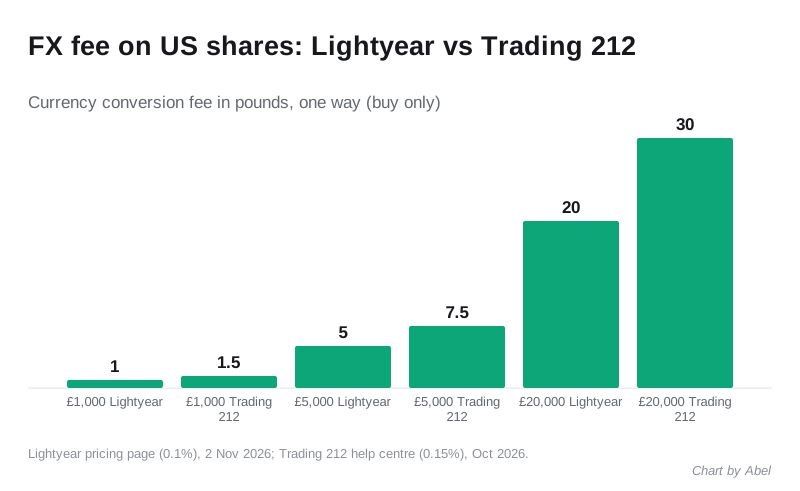
The FX fee applies whenever you buy something priced in dollars or euros, such as Apple, Nvidia or a US-listed ETF, and again when you sell it. Lightyear charges 0.1% and Trading 212 charges 0.15%, so on the same trade Trading 212 costs half as much again.
| US shares bought | Lightyear (0.1%) | Trading 212 (0.15%) | Difference |
|---|---|---|---|
| £1,000 | £1 | £1.50 | 50p |
| £5,000 | £5 | £7.50 | £2.50 |
| £20,000 (a full ISA allowance) | £20 | £30 | £10 |
Double each figure for a round trip, as you pay the fee again when you sell. Someone filling a whole ISA with US shares saves around £10 a year at Lightyear, which is real money but not a reason to change apps on its own.
You can avoid the FX fee at either app by buying funds that trade in pounds on the London Stock Exchange. Most global trackers have a GBP-traded version, and buying that instead of the US-listed fund costs nothing to convert. UK shares carry 0.5% stamp duty at both apps, because that is a government tax rather than a platform fee. Most ETFs are exempt.
Bank transfers in are free at both. Lightyear charges 0.6% on card top-ups, so fund it by bank transfer. Trading 212 now also lets you set up recurring deposits paid straight from your bank through TrueLayer, which removes the problem of an expired card stopping a regular investment.
Interest on cash: Vaults vs Trading 212’s interest
This is where the two apps really work differently.
Lightyear Vaults are BlackRock money market funds in pounds, dollars or euros. Lightyear shows the fund’s one-day yield, takes a 0.20% fee and quotes what is left as an AER. On 2 November that was 3.89% in pounds. You can hold a Vault inside the Stocks and Shares ISA, so the interest is tax-free there. Plain uninvested cash in a Lightyear account earns a lower rate, so if you are holding money for more than a few days you need to move it into a Vault yourself.
Trading 212 pays interest on uninvested cash in the Invest account and the Stocks and Shares ISA once you switch it on. It is worked out at 22:00 GMT on your free cash and paid daily, with no minimum or maximum. Part of that cash can go into qualifying money market funds rather than a bank, which you have to agree to when you switch interest on. The rate for new clients is published by Trading 212 and your own rate shows in the app. We explain how it is held and protected in Trading 212 interest on cash explained.
The practical difference: Trading 212 does it for you once interest is on, and Lightyear makes you move cash into a Vault. In both cases money in a money market fund is an investment, not a bank deposit, so the £120,000 deposit guarantee does not cover it. These funds hold very short-term, high-grade debt and are designed to keep a steady value, but the rate changes daily and is not guaranteed.
Cash ISAs
Both apps run a flexible Cash ISA that tracks the Bank of England rate, so the rate moves automatically when the Bank moves.
- Lightyear’s Cash ISA follows Bank Rate. It paid 3.75% AER on 2 November, matching Bank Rate before the 5 November rise.
- Trading 212’s Cash ISA is set at Bank Rate minus 0.15%, and its cash is held in deposits with partner banks. Interest accrues daily and is paid on the third day of each month.
On those terms Lightyear’s Cash ISA pays slightly more, roughly 0.15 percentage points. On £10,000 that is about £15 a year. The Cash ISA allowance shares the £20,000 annual ISA limit with your Stocks and Shares ISA. Trading 212 has at times offered new customers a boosted rate for the first 12 months, so compare the rate you are actually offered. Our page on the Cash ISA limit cut in 2027 covers what changes from April 2027.
Pensions: Trading 212’s clear win
Trading 212 has a SIPP with no account, dealing or custody fee, run on the same app as the ISA. Lightyear has no pension, no Lifetime ISA and no Junior ISA. Neither app offers a Lifetime ISA, so if you are saving for a first home you need a third provider; our best Lifetime ISA apps page lists the options.
If you want your ISA and your pension in one place, with the same funds and the same automatic investing, that decides it for Trading 212.
Building a portfolio: Pies vs Plans
Both apps now let you group investments into a mini-portfolio and fund it automatically. Trading 212 calls them Pies: you pick shares and ETFs, give each a target percentage, and AutoInvest puts money in on a schedule and keeps the split. You can also copy ready-made Pies, though a stranger’s portfolio may not suit you.
Lightyear’s version is Plans. You group holdings into a Plan, switch on Auto-invest and choose weekly, fortnightly or monthly. Lightyear’s help centre lists the limits: investments that cannot be bought in fractions cannot be auto-invested, and Vaults and cash cannot go in a Plan. You also set up the standing order from your bank yourself, whereas Trading 212 can now pull the deposit from your bank for you.
For one or two trackers bought monthly, the two are equivalent. Pies are the more mature tool if you want a larger portfolio run hands-off.
Safety
Both are authorised by the Financial Conduct Authority, Lightyear under firm reference number 987226. Both keep client investments separate from their own money, and the Financial Services Compensation Scheme covers up to £85,000 per person if the firm fails and your assets are missing. That cover is for the platform failing, not for your investments falling in value. Cash at their partner banks gets deposit protection up to £120,000 per banking group; cash in money market funds does not. You can check either firm on the FCA Register and read how compensation works on the FSCS website. Our is my money safe in an investing app page goes through it in more detail.
Which should you choose?
Choose Lightyear if you:
- buy US or European shares often and want the lowest FX fee of the big UK apps
- want a Stocks and Shares ISA and a Cash ISA, and keep your pension elsewhere
- are happy to move spare cash into a Vault yourself
Choose Trading 212 if you:
- want a SIPP in the same app as your ISA
- want Pies and AutoInvest to run a multi-fund portfolio, with deposits pulled from your bank
- want interest on spare cash without moving it anywhere
Plenty of people use both: Lightyear for US shares at 0.1%, and Trading 212 for the SIPP. Moving an ISA between them is free on both sides; see how to transfer an ISA between apps. For the full detail on each app, read our Lightyear review and Trading 212 review, or compare them with the rest in best stocks and shares ISA apps.
Frequently asked questions
Is Lightyear cheaper than Trading 212? Only on currency conversion. Lightyear charges 0.1% FX and Trading 212 charges 0.15%, so £5,000 of US shares costs £5 to convert at Lightyear and £7.50 at Trading 212. Neither charges commission, an account fee or a custody fee.
Does Lightyear have a SIPP like Trading 212? No. Lightyear offers a Stocks and Shares ISA, a Cash ISA, a general account and a business account, but no pension. Trading 212 has a SIPP with no account or dealing fee.
Which pays more interest on cash, Lightyear or Trading 212? It depends on the account. Lightyear’s Cash ISA follows Bank Rate, while Trading 212’s is Bank Rate minus 0.15%, so Lightyear pays a little more there. For spare cash in an investing account, compare Lightyear’s Vault rate with Trading 212’s rate in the app on the day, because both change daily.
Is money in Lightyear Vaults protected like a savings account? No. A Vault is a money market fund, so it is an investment rather than a bank deposit and the £120,000 deposit guarantee does not apply. FSCS investment cover of up to £85,000 applies if Lightyear itself fails and your holdings are missing.
Can I transfer my ISA from Trading 212 to Lightyear? Yes. Start the transfer from the app you are moving to, and it requests the money from the old provider. Neither app charges for transfers, and using the transfer process keeps your money inside the ISA wrapper.
Do either of them offer a Lifetime ISA? No. Neither Lightyear nor Trading 212 offers a Lifetime ISA, so you would need a separate provider for the 25% government bonus.